
What is A2P 10DLC and the TCR?
A2P10 DLC is a phone number registration process mandated by the United States government, specifically through The Campaign Registry (TCR). It is a required registration process for any business or individual engaging with a U.S. audience via outbound SMS. The purpose is to ensure legitimacy and adherence to guidelines when sending marketing and promotional text messages.
“A2P” is short for Application to Person. In this case, Virelynx is the application, and the recipient you wish to send SMS or MMS to is the person.
“10 DLC” is short for 10 Digit Long Code. This is both the number of digits US phone numbers contain as well as the name of the new standard.
"The Campaign Registry (TCR)" works with North American mobile operators and companies that are in the messaging business to register Application-to-Person (A2P) text messaging Campaigns. The registry supports a sanctioned A2P 10 Digit Long Code (10DLC) text messaging Campaign ecosystem and provides visibility into the messaging source and content, allowing mobile carriers to provide a more reliable and simple messaging service for Campaign Service Providers (CSPs) and Brands.
What do I need to do?
If you do not send any messages to users in the United States using long code numbers, you do not need to do anything. If you send messages to the United States using long code numbers, you have the following registration options based on your Tax ID status, volume, and use case.
Types of Brand Registration
There are four main types of Phone Registration and each have a specific use-case and pros and cons.
Toll-Free Number
Sole Prop
Low Volume Standard
Standard
How does A2P 10DLC work?
There are two important requirements under the new A2P 10DLC system:
➤ Businesses must identify who they are to the carrier networks (Brand registration).
➤ Businesses must register what type of messages they send, i.e., notifications (Campaign registration).
Registration is done entirely through the Phone System Trust Center. We have integrated with The Campaign Registry (TCR) to meet carriers' requirements while making it easy for businesses to onboard.
The Registration Process
There is a three-step process to having your numbers vetted and approved before you can send SMS. Let's get a quick rundown of the process.
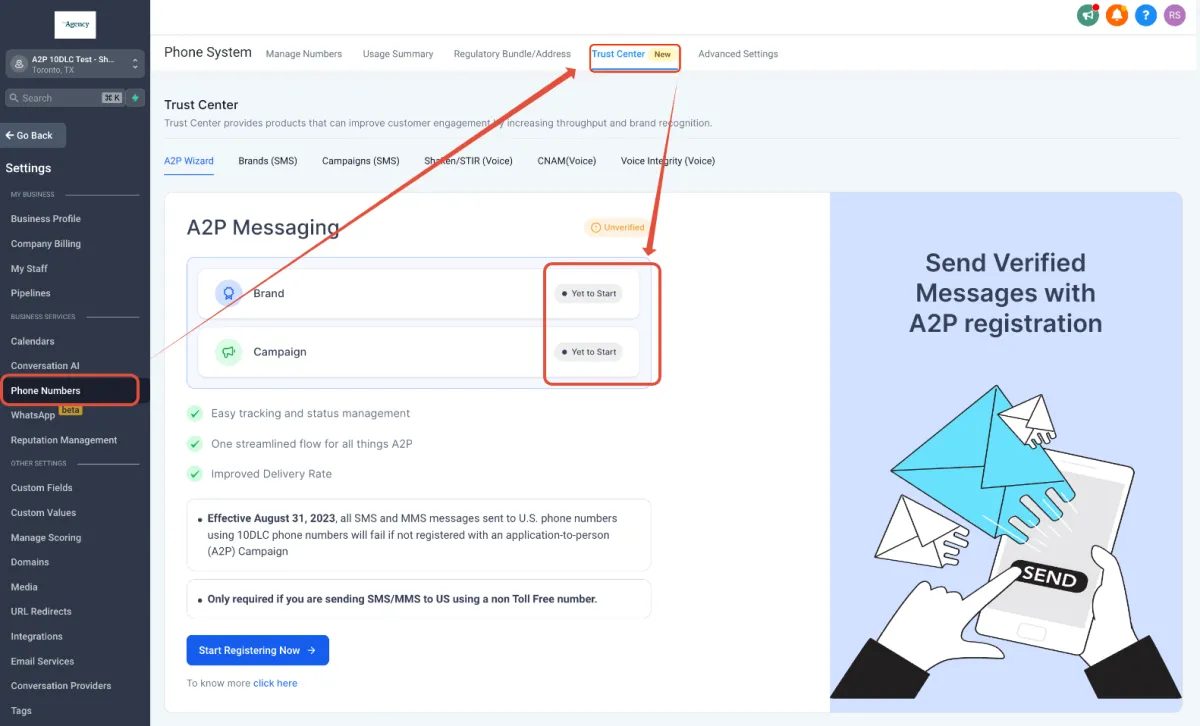
Brand Registration
The client will submit business information to be reviewed. Failed or rejected Brand Submissions will need to be updated and resubmitted. Your Brand Submission must be approved before your Campaign submission is vetted.
Campaign Registration
After your Brand is approved, your Campaign Submission is reviewed. A campaign submission provides the TCR with the specifics of your messaging and business usage of SMS/MMS. Failed submissions will need to be updated and resubmitted.
Carrier Propagation
After Brand and Campaign approval, it can take up to 3 business days or longer for all carriers to receive this new information. While you can get sending immediately following approval, you may find some messages will fail - appearing with an error code saying no A2P approval is found. Rest assured! This is normal and common as it can take several business days for all carriers to receive your registered information. If the issue persists for more than 4 business days, contact Support.
Pro Tip:
Submit both a Toll-Free then a Non Toll-Free Number registration to try to get sending faster!
Number registration takes 4–6 weeks, but Toll-Free approval can take as little as two days (not guaranteed). Start with Toll-Free Registration, then submit your Sole Prop, Low Volume Standard, or Standard Campaign. This often lets you start sending sooner. Once approved, you can switch to your local number.
Registration Comparison Table
Below we will compare and contrast the types of registrations to help you choose the best one for your business needs.
Note: A Tax ID is a US EIN or a valid International business registration number.
A Tax ID is required for Low Volume Standard or Standard. Don't have one? check out the FAQ below.
Additional Pricing Information
Prices are subject to change from time to time based on industry and provider changes.
Brand, Registration & Campaign Fees are applied at the time of submission and vetting.
Registration fees do not include Phone Number, Voice, SMS, and MMS charges, which are charged separately.
LC Messaging Policy, Segments & Sending Limits
Sending limits shown are still subject to LC Messaging and Ramp Up Policy.
Sending limits are based on daily sending to US numbers and are subject to other sending limits as imposed by carriers, such as T-Mobile hard limits.
Avoid suspensions: When sending SMS, you must maintain an Opt-Out rate of less than 3%. If you surpass this amount, messaging will be temporarily suspended for 24 hours.
What is a Segment? Limits reflected are based on Segments. Segments are how text messages are processed and sent. A text message can have 2 or more segments per text.
Find the number of segments in a message with this Segment Calculator. Use the image below to see where segments are notated in the Segment Calculator. You can click the image to enlarge it.
Forbidden Messaging and Use-Case Categories
Some business use cases and messaging content is prohibited.
Businesses submitting a registration for prohibited categories will not be approved.
Businesses sending SMS/MMS messages with prohibited content within it, regardless of approved campaign or not, may result in the revoking of approved campaigns, carrier fines, and more.
Forbidden message categories for SMS/MMS in the U.S./Canada
Please Note: Any use cases that violate this policy will not be allowed on the LeadConnector ISV platform, regardless of number/sender type or destination country.
New Sev-0 Fines on Prohibited A2P Traffic, Effective February 15, 2024
What do you need to know?
T-Mobile has introduced A2P 10DLC non-compliance fines for messages including prohibited content. If T-Mobile detects any messages that violate the tiers listed below, they will issue a Sev-0 violation (the most severe consumer violation), a non-compliance fine, and carriers will immediately block the offending messages.
This applies to all commercial messaging non-consumer A2P products (SMS or MMS short code, toll-free, and 10DLC) that traverse the T-Mobile network.
Because Sev-0 violations also infringe on Virelynx acceptable use and messaging policies, Virelynx will pass on these fines to you for every Sev-0 violation, starting February 15, 2024. These fines include, but are not limited to, the following:
➤ Tier 1: $2,000: phishing (including simulated phishing sent for security testing or similar purposes), smishing, and social engineering. Social Engineering is a technique used to manipulate someone into sharing private information, like passwords or credit card numbers.
➤ Tier 2: $1,000: illegal content (content must be legal federally and in all 50 states)
➤ Tier 3: $500: all other violations in commercial messaging including but not limited to, SHAFT (sex, hate, alcohol, firearms, and tobacco) that do not follow federal and state law and regulations (e.g. age-gate).
These non-compliance fines apply to violations across any A2P messaging product (SMS/MMS short code, toll-free, and 10DLC).
T-Mobile reserves the right to permanently suspend any brands, campaigns, and your company’s access to the T-Mobile Network in the event violations are deemed to be excessive. If you are subject to these fines, Virelynx will send you a Sev-0 violation notice and will subsequently charge the respective fine amount.
Forbidden Message & Use-Case Categories
My use case is listed as forbidden. What can I do?
If your use case is listed above as forbidden for SMS and MMS messaging in the US, you can explore other marketing channels.
Avoid Failures and Get the Fastest Approval Time Possible
Virelynx has no part in the vetting or approval process after submission. However, we do try our best to help you provide a detailed and accurate submission to ensure a review can take place.
PRO TIP:
Reviewing common reasons for failure BEFORE submitting your Brand or Campaign will help avoid common failure reasons and ensure the fastest approval time possible. Submitting accurate information during your first submission will assist in a faster review.
Required information for United States A2P 10DLC registration
Standard and Low Volume Standard Brands
Business Information
Business Name
Physical Address (Street, City, State/Province/Region, Postal Code, Country)
Business Identity (Direct Customer or ISV/Reseller/Partner)
Business Type (Sole Proprietorship/Partnership/Corporation /Co-Operative/LLC/Non-Profit)
Company Status (Private/Public)
Stock Ticker & Exchange (if Public)
Business Registration Number & Type (EIN for US-based companies, other business identifiers for non-US companies)
Industry
Website
Regions of Operations
Points of Contact
Points of Contact
One authorized representative with the following info:
Name
Email
Title
Phone Number
Job Position (Director/VP/GM/General Counsel/CEO/CFO)
A second point-of-contact may also be provided, but is optional.
Sole Proprietor Brands
Sole Proprietor registration is available now. The following requirements will apply.
No Tax ID (EIN): To qualify for Sole Proprietor registration, you must not have an EIN (Employer Identification Number). Any business with a Tax ID (EIN) is not eligible and should instead register for a Low Volume Standard Brand.
US or Canada only: Sole Proprietor Brands are limited to individuals in the US and Canada.
Information required for registration:
Brand or business name
First name
Last name
Email address
Mobile phone number (in US or Canada)
Physical address (in US or Canada)
Each mobile phone number can only be used to validate up to 3 brands. Each email or physical address can only be used to validate up to 10 brands. This limit applies for all A2P registrations within the ecosystem, even brands registered outside of LeadConnector.
What’s a campaign use case?
This represents a messaging use case, for example, sending account notifications or conducting marketing. In carrier terminology, these are called "Campaigns." For more specificity, Phone System is calling them campaign use cases.
Some companies may only need to register one campaign use case; in other scenarios, you may have multiple. For example, if you are a company that sends authentication codes to validate new users but also sends marketing messages, you should register two campaign use cases.
What does the campaign use case options mean?
Your campaign use case describes the type of messaging you plan to send. This will influence the price you pay per message.
Use cases vary from notifications and fraud alerts to customer care to social updates. For more information on Campaigns and a full list of campaign use cases, please see the following:
What Are Campaign Use Case Types?
Campaign use case types represent the specific purpose of your SMS or MMS messages. When registering a campaign, you're required to select a use case that accurately describes the nature of your communication—such as customer care, two-factor authentication, or marketing. Choosing the correct campaign type is essential to meet industry compliance standards, avoid filtering or blocking, and maintain trust with carriers and recipients.
Key Benefits of Choosing the Right Use Case
Selecting the right campaign use case helps ensure that your messages are delivered reliably, compliantly, and with minimal delays in the application process.
Reduces the risk of campaign rejection by The Campaign Registry (TCR)
Helps carriers understand message intent and enforce spam filtering
Aligns your messaging practices with industry and legal standards
Supports faster approval and fewer compliance flags
Improves long-term deliverability and reputation
List of Approved Campaign Use Case Types
Below is a table of commonly accepted campaign use case types as defined by The Campaign Registry. Choose the one that best fits your messaging intent when registering your campaign.
Special Campaign Use Cases
Certain campaigns are categorized as "special" by carriers and require additional documentation, verification, or pre-qualification. These often involve sensitive or regulated communications. Special use cases may involve different fees, verification requirements, and carrier-specific restrictions.
Charity / 501(c)(3) Nonprofit: For registered nonprofit organizations conducting charitable outreach. Must provide IRS nonprofit verification.
Emergency Services: Used by government agencies to deliver urgent safety or emergency messages. Strictly limited and regulated.
Political: For political messaging, including campaigns, parties, and PACs. Requires verification through Campaign Verify.
Low-Volume Use Cases
In addition to the standard “Mixed” or “Marketing” campaign types, there is a dedicated use case called Low Volume Mixed. This option is intended for businesses with lighter SMS needs. It supports the same range of message types as a standard Mixed campaign—such as marketing, customer care, and notifications—but comes with a lower monthly fee. Unlike other campaign types, Low Volume Mixed is locked to the lowest available throughput tier, regardless of the brand’s Trust Score. This makes it an ideal, cost-effective choice for small businesses or organizations that don’t require high-volume messaging.
Understanding A2P 10DLC Messaging Fees: Registration, Monthly, and Carrier Costs
A2P 10DLC is the messaging standard required for sending SMS/MMS messages to U.S. mobile numbers using local business phone numbers. All businesses using LC Phone must register their brand and campaigns through The Campaign Registry (TCR). This reference outlines all applicable fees, including registration, vetting, monthly campaign charges, and carrier message rates.
A2P 10DLC Pricing Overview
There are three primary categories of fees involved in A2P 10DLC messaging. These charges are set by The Campaign Registry (TCR), Twilio, and mobile carriers—and are passed through directly via LC Phone with no markup from Virelynx.
Brand Registration and Campaign Vetting Fees cover the cost of submitting your business brand and messaging campaigns to The Campaign Registry for compliance verification. These are one-time charges required to activate your ability to send messages through A2P 10DLC.
Monthly Campaign Fees are recurring charges applied to each active campaign based on its selected messaging use case. These fees are billed monthly as long as the campaign remains active and are paid to The Campaign Registry.
Carrier Message Fees are charged by mobile carriers (e.g., AT&T, T-Mobile, Verizon) for each outbound SMS segment or MMS message sent over their networks. Some carriers—like T-Mobile—also apply fees to inbound traffic.
Note: Rates are current as of May 5, 2025 for US only.
Brand Registration and Campaign Vetting Fees
When registering for A2P 10DLC, both the brand and campaign must be submitted through the Trust Center. Virelynx presents these as a single, bundled one-time fee at the time of registration. This bundled amount includes:
Brand Registration
Campaign Vetting
Fast Track Processing ($3) to expedite approval within 3 business days
Monthly campaign fees are billed separately and vary based on campaign use case and volume. If a campaign is rejected and resubmitted, an additional Campaign Vetting Fee will be charged for each resubmission.
Brand Types (Registration Tier) and Initial Fees
*High Volume Bundle Includes Secondary Vetting for A2P 10DLC in case of first submission being rejected.
Additional Campaigns and Resubmissions
The bundled one-time fee is only charged during the initial registration of your brand and first campaign. It does not apply to future campaigns under the same brand.
Submitting another campaign under the same brand:
You will only pay the Campaign Vetting Fee of $15.00 per additional campaign.
Resubmitting a rejected campaign:
Each resubmission also incurs the $15.00 Campaign Vetting Fee again. High Volume Standard submissions include a second submission in the initial bundle price.
Monthly Campaign Fees
Monthly campaign fees are recurring charges based on the messaging use case selected during campaign registration. Each campaign type has a monthly rate defined by TCR. Certain use cases may require additional vetting or documentation. Fees may vary based on use case sub-type.
*The Low Volume Mixed use case supports up to 2,000 SMS segments per day to T-Mobile and receives lower throughput regardless of Trust Score.
For additional information identifying the correct campaign type for your use case, click here.
Per-Message Carrier Fees
Carrier fees are applied per message segment and vary based on registration status and carrier. These are charged in addition to the LC Phone messaging rates.
Carriers may block or surcharge unregistered messages. Ensure your numbers are linked to registered A2P campaigns.
Note: T-Mobile acquired the Sprint network in 2020. Some devices still appear as "Sprint" in a Lookup. Messages sent to these users will have the same fees as other messages to T-Mobile.
SMS, MMS, and Voice Usage Rates via LC Phone
In addition to carrier and campaign fees, LC Phone usage is billed at Twilio’s base passthrough rates. These include costs for sending and receiving SMS/MMS and voice calls. All rates are by segment and apply to both toll-free and local numbers unless otherwise noted.
LC Phone Pricing & Billing Guide
This guide outlines the full pricing structure for the LC Phone system within Virelynx. It covers everything from phone number costs, SMS/MMS messaging, voice calling rates, and carrier passthrough fees, to rebilling options for agencies using SaaS mode. However, the pricing for LC Phone System is the same amount as Twilio. All the prices shown for LC Phone features are listed in USD.
Pricing based on the most used Product Categories
This pricing guide outlines costs based on the most commonly used LC Phone product categories — including local/toll-free numbers, messaging (SMS/MMS), voice calls, and optional rebilling charges for SaaS agencies.
1. Phone Numbers
All the phone numbers are charged monthly based on the number types. Below is the list of pricing for different number types available in the US/Canada:
Local Numbers: $1.15 / month
Toll-Free Numbers: $2.15 / month
For all the other countries, the pricing will also be based on Twilio's pricing.
2. Messaging Service - SMS
The SMS pricing is based on the number of segments a message has, the pricing in US/Canada is as follows:
This pricing is both for the local and toll-free numbers. For all the other countries, the pricing will also be based on Twilio's pricing.
3. Messaging Service - MMS
The MMS pricing is based on the number of segments a message comprising of, the pricing for US/Canada is as follows:
For all the other countries, the pricing will also be based on Twilio's pricing.
Tip: For calculating segments and understanding more about how to calculate the per SMS and MMS cost, refer to How to Calculate SMS and MMS Costs.
4. Voice Calls
The cost of voice calls depends on call duration (per minute). Below is a detailed breakdown for US and Canada.
Outbound Calls
Total Cost: $0.0166 per minute
Breakdown:
Outbound USA: $0.0126/min
(includes 10% discount on list price of $0.014)
Client Minutes: $0.004/min
Inbound Calls
Inbound calls generally consist of two legs:
Incoming call to your Virelynx number (from the caller)
Forwarded call to wherever you answer it , e.g., web, mobile, desk phone, or another number
Charges apply for both legs, depending on where you answer.
If Answered on Web, Mobile, or Deskphone
Total Cost: $0.01165 per minute
Breakdown:
Incoming Call (USA): $0.00765/min
(includes 10% discount on list price of $0.0085)
Client Minutes: $0.004/min
Note: Voice AI calls may add $0.004/min if the provider uses SIP infrastructure.
If Answered on a USA Forwarding Number
Total Cost: $0.02 per minute
Breakdown:
Incoming Call (USA): $0.00765/min
Outgoing Call (to your forwarding number): $0.0126/min
Explanation:
If you forward your HighLevel number to a US phone number or any other phone number you’ll pay for both the incoming and outgoing portions of the call.
Important Notes
International Forwarding:
If you forward incomming call to an international number (e.g., UK mobile), the second leg follows Twilio’s international rates, which are higher.
View Twilio’s Local, Mobile, and Toll-Free International Rates
Regional Exceptions:
Calls to Alaska and Yukon Territory follow Twilio’s regional pricing and are not billed at the standard US/Canada rates.
Other Countries:
For all other regions, pricing is based on Twilio’s international call rates.
Billing Rounding:
Calls are billed in full minutes.
Any partial minute is rounded up to the next whole minute.
Call Reporting: Reports display the exact call duration, even if billing rounds up.
Example:
Number of Calls: 2
Actual Duration in call reports: 45 seconds each (1m 30s total)
Billed Duration: 2 minutes total
Summary: Call reporting shows precise durations for transparency, while billing uses the rounded-up minute for calculation.
Please Note: The outbound calls have 2 legs so the cost of an outbound call will be $0.0180 ($0.014 for Outbound call + $0.004 for the webApp/MobileApp leg which dialer uses to initiate the call (Client Minutes))
5. Number Intelligence
Number Intelligence is a bundle of three functions. All three are turned on/off together, refer to Number Intelligence - Number Validation, Spam Detection, and Unknown Caller.
Number Validation ($0.005/call): before sending an SMS, check if the number is valid, if invalid do not send the SMS.
Spam Detection ($0.005/test): when receiving an incoming US call, test it for spam, mark is "spam likely" if it fails the test.
Name Lookup ($0.01/lookup): when receiving an incoming US call, if the number is not on a contact or the contact name is empty, look up the caller's name.
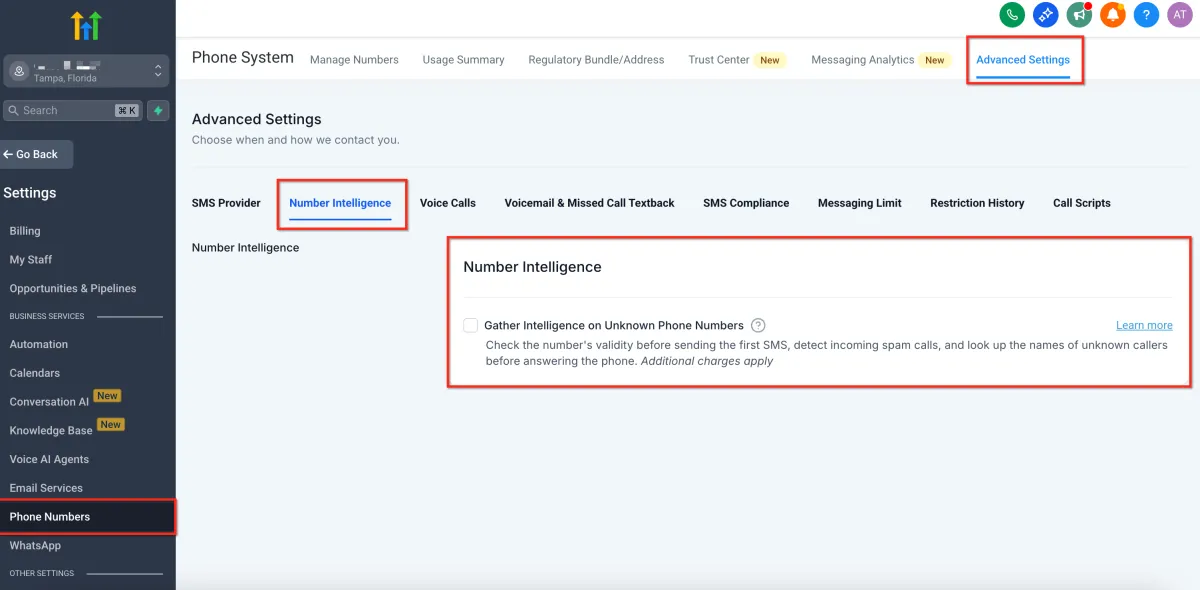
Number Format Lookups: All the number formats look up to support calls are free of cost.
6. A2P Pricing
Here’s how A2P Brand and Campaign registration fees apply for both Low Volume and High Volume campaigns:
Important:
Monthly campaign fees are determined by The Campaign Registry (TCR) and may still apply even if a campaign fails, is rejected, or requires resubmission.
The $3 Fast Track fee ensures faster campaign approval and is included in the one-time registration cost.
7. Other Charges
Below are some additional categories that are also charged at the same price as Twilio:
Client Minutes for Calling ($0.004 per minute, already included in the outgoing call charges shared above, SaaS rebilling applies)
Call Recording ($0.0025 per minute of recording, SaaS rebilling applies)
Call Recording storage ($0.0005 per minute of recording per month, SaaS rebilling applies)
Call Transcription ($0.024 per minute, SaaS rebilling applies)
Answering Machine Detection ($0.0075 per call where it is used, SaaS rebilling applies)
Voicemail drops ($0.0180 / minute, SaaS rebilling applies, same charge as an outgoing call)
Conference Calls ($0.0018 - $0.0040 per minute per participant depending on region used, SaaS rebilling applies)
US: $0.0018 /participant/minute
Dublin: $0.0025 /participant/minute
Tokyo: $0.0030 /participant/minute
Singapore: $0.0030 /participant/minute
Sydney: $0.0030 /participant/minute
Sau Paulo: $0.0040 /participant/minute
Conference Call is used for all outgoing calls. It is also used for Incoming calls that are transferred.
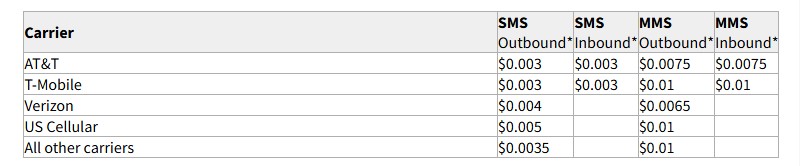
SMS carrier fees are charges that are applied by the recipients carrier to the sender, These charges + SMS charge is the total cost to send an SMS. Some carriers charge fees on long code SMS (messages sent from a 10-digit US/Canada number). Other carriers only charge fees for SMS sent from a Short code number.
There are additional carrier fees per message that are automatically applied based on the end-user's destination and carrier.
Amazon Polly Text-to-Speech charges(The new, enhanced speech feature costs US$0.00084 per 100 characters of text.
FAQs
Q: What happens if I choose the wrong campaign use case?
Choosing the wrong use case can lead to campaign rejection, delivery filtering, or compliance issues. Always select the use case that best matches the primary intent of your messages.
Q: Can I register more than one campaign use case?
Yes. If your business sends different types of messages (e.g., marketing and customer support), you may need to register multiple campaigns, each with its appropriate use case.
Q: Can I switch my campaign use case after it’s approved?
No. To change your use case, you'll need to register a new campaign with the updated details and sample messages.
Q: Is Cold Texting Allowed?
Cold Texting is when someone sends an SMS to a recipient who did not opt-in or agreed for you to message them. In other words, you are sending an SMS to someone who did not want to receive a message from you. This breaks TCR guidelines, carrier guidelines, and Phone System messaging policy. If you have not received explicit consent to message someone via SMS, do not message them. Those found cold messaging may not be approved for increased sending limits and are at a high risk for SMS Suspension.
Q: What information is required for registration?
You will need information about each business and brand to register businesses, brands, and use cases. The required info includes the business name, physical address, and business type (LLC, partnership, etc.).
Q: Do I need to go directly to The Campaign Registry or any other non-LC Phone System website to complete registration?
No. Registration can be completed entirely through the Phone System. Phone System has integrated directly with The Campaign Registry (TCR) to facilitate registration for our customers.
Q: What if I do not have a valid Tax ID, how do I register my phone number?
Toll-Free will be the best option to begin with, for any user, especially those without a Tax ID and/or without a US or CA Business Address.
Many Businesses attempt a Sole Prop after a US or CA Business Address.
In addition, some businesses choose to get a Tax ID or International Business Registration and then attempt Low Volume Standard or Standard. There are always restrictions and acquiring a US and CA Business Address or valid International Business Registration does not guarantee approval.
Consulting legal counsel is always the best option when navigating legal needs.
Q: When submitting my Contact or Business Phone (OTP), can I reuse a number or use my Virelynx Number?
You cannot use a number purchased within the Virelynx platform (or CPaaS phone number such as one obtained from Twilio.) Please provide a mobile number that you have access to confirm OTP verification.
Only US/Canadian numbers will be accepted.
You cannot use the same mobile number to register more than 3 Sole Proprietor brands.
This limit is managed at the TCR level.
Q: Is MMS messaging affected by A2P 10DLC?
Yes, MMS messaging via long code is subject to carrier fees as part of A2P 10DLC. We also expect registered MMS traffic to ultimately benefit from reduced carrier filtering. However, long code MMS messaging remains subject to throughput limits due to limited carrier capacity. A short-code is still the best option for high-volume MMS use cases in the United States.
Q: Is WhatsApp messaging affected by A2P 10DLC?
No. WhatsApp messaging is unaffected by any of these changes. WhatsApp messages are transmitted over the Internet rather than through carrier networks like SMS and MMS.
Q: What if your address has changed since you received the CP 575 form?
Suppose your address has changed since you received the CP 575 form, which is the form issued by the Internal Revenue Service (IRS) to assign an Employer Identification Number (EIN). In that case, updating your address with the IRS is important to ensure they have your current contact information.
To update your address with the IRS, you can follow these steps:
1. Fill out Form 8822, "Change of Address," which is the official form to notify the IRS of your new address. You can obtain this form from the IRS website or by contacting the IRS directly.
2. Provide your updated address information on Form 8822, including your EIN, old address, and new address.
3. Sign and date the form.
4. Mail the completed Form 8822 to the appropriate IRS address as specified in the form's instructions. Make sure to send it to the correct IRS office based on your location and the type of entity you are (e.g., individual, corporation, partnership).
By updating your address with the IRS, you ensure that they have accurate information for your business and can send important correspondence and documents to the correct address.
It's also a good practice to update your address with any other relevant entities, such as your state or local tax authorities, business partners, and service providers, to ensure they have your current contact information.
Q: What is a Trust Score, and how does it affect me?
When you complete the registration of your Brand and Campaign(s) for A2P Messaging through the Phone System Console, that information is sent from Phone System to The Campaign Registry (TCR), a 3rd party at the center of this new registration system. Phone System automatically submits your Brand for secondary vetting, which uses a reputation algorithm to review specific criteria relating to your company and assign a Trust Score to determine your messaging throughput and T-Mobile daily message limits.
Your Trust Score determines how many messages per second (MPS) your campaign can send. While there’s no direct fee associated with Trust Scores, they influence deliverability and messaging performance. A higher score results in higher throughput and fewer carrier filtering issues.
Q: How do Trust Scores influence message throughput?
Trust Scores are grouped into three levels, from lowest to highest. Your Trust Score level and Campaign Type will determine the message throughput allocated to your campaign use case.
Q: Can I buy new phone numbers to use this A2P 10DLC service?
Buying new numbers is unnecessary if you already use long code numbers. Following the registration process will enable your existing numbers to use the new A2P 10DLC service.
Q: What pricing and fees are associated with the A2P 10DLC service?
For an overview of registration costs and per-message carrier fees associated with A2P 10DLC, please see the pricing and fees associated with the A2P 10DLC service.
Q: How long does it take to get registered?
A2P 10DLC registration is a multiple-step process that includes registering a Business Profile, a US A2P Brand, and a Campaign use case.
Brand registration can typically be completed in a few minutes if you've collected all the required information. For example, when registering a US-based business, you should ensure your Employer Identification Number (EIN) is ready when you begin registration. However, in the event that there is a discrepancy with the information you provide, a manual review may be required for Secondary Vetting, which can take up to 7 days. To avoid this, please see A2P 10 DLC Brand Approval Best Practices.
Q: Once I complete registration, how do I ensure my phone numbers use 10DLC?
Once your Brand(s) and Campaign(s) are approved, you must link each of your A2P Campaign Use Cases to a Messaging Service and add phone numbers to that Messaging Service. Any numbers that you add to that Messaging Service will be automatically associated with the Campaign that you linked to that Messaging Service.
Q: What message-sending throughput (MPS) do I get?
Message throughput (MPS) will be allocated per registered Campaign Use Case. For many customers, A2P 10DLC will offer much higher throughput than the traditional 1 MPS for long code messaging without requiring additional numbers to get higher throughput.
For details, see Message throughput (MPS) and Trust Scores for A2P 10DLC in the US.
Q: Can I start texting the same day I register?
Yes, but they will get filtered after a couple of messages are sent and will receive a 30007: Message filtered. A workaround until the brand is approved would be to get a toll-free number.
Q: Does this A2P Registration differ if we are using Twilio numbers through Virelynx?
Yes, if you use your own Twilio account directly, you will complete the registration through your Twilio console. However, it is still necessary to have done, even if you are not using the Virelynx.
Q: Do I need to pay the vetting fee more than once?
The Campaign Vetting Fee is charged for every campaign you submit, including the first campaign and any additional ones under the same brand. If a campaign is rejected and resubmitted, the fee is also charged again for each resubmission attempt.
Q: Is the Brand Registration Fee charged for every campaign I create?
No. The Brand Registration Fee is charged only once when you register a new brand. If you submit additional campaigns under the same brand, only the Campaign Vetting Fee applies.
Q: Are these fees charged by Virelynx?
No. All A2P 10DLC fees are passthrough charges from The Campaign Registry (TCR), Twilio, and U.S. mobile carriers. Virelynx does not add markup to these charges.
Q: Can these prices change?
Yes. Prices are determined by external providers (TCR, Twilio, carriers) and may be adjusted at any time. Always review the current pricing displayed in the Trust Center before submitting a campaign.
Q: What is a message segment?
A message segment refers to a single unit of text used for billing SMS messages. Most U.S. carriers define one segment as 160 characters of plain text. If your message exceeds 160 characters, it will be split into multiple segments and billed accordingly.
Q: Why am I being charged for incoming SMS?
LC Phone charges for both inbound and outbound SMS at the same rate.
Q. I was billed $20 right away. However, I haven't called anyone yet and have only created one phone number. Is this expected?
Yes, the wallet would have auto-recharged as soon as the balance is below the amount set in the wallet configurator.
Q.Will I be charged if I encounter an error when sending an SMS?
If there's an internal error with LC Phone before the message is handed off to the phone provider, you won't be charged. However, charges apply to every message where a delivery attempt has been made, regardless of the final delivery status. This includes messages sent from toll-free numbers, A2P numbers, and those not deliverable due to country restrictions or other factors. We urge users to be fully informed and cautious before sending messages, as refunds will not be provided for undelivered SMS.
Q. Why am I getting charged for Call Recording Storage even though I didn't record calls recently?
Any Call Recording stored incurs storage charges. This means older call recordings also incur these storage charges. If you want to avoid these charges:
➤ Retain recent call recordings and delete older ones using the feature "Automatically Delete Older Recordings" under Sub-account settings > Phone Numbers > Advanced Settings > Voice Calls > Call Recording
➤ Delete all call recordings to avoid all storage charges. Set the time period in the above feature to 1 day and disable call recording for future calls
Q. Why do I pay for Conference Call charges for all outgoing calls (even the ones without call transfer)?
Our outgoing call flow is optimised to be seamless, with lower waiting times and quicker transfers. Thus, we initiate a Conference Call for all outgoing calls as per our standard call flow implementation.

Virelynx is the apex automation engine, purpose-built for growth-driven entrepreneurs, marketers, and agencies who demand efficiency without compromise. By fusing CRM precision with agile automation, it streamlines every moving part of your business, from lead capture to client retention.
© 2025 Virelynx All Rights Reserved.